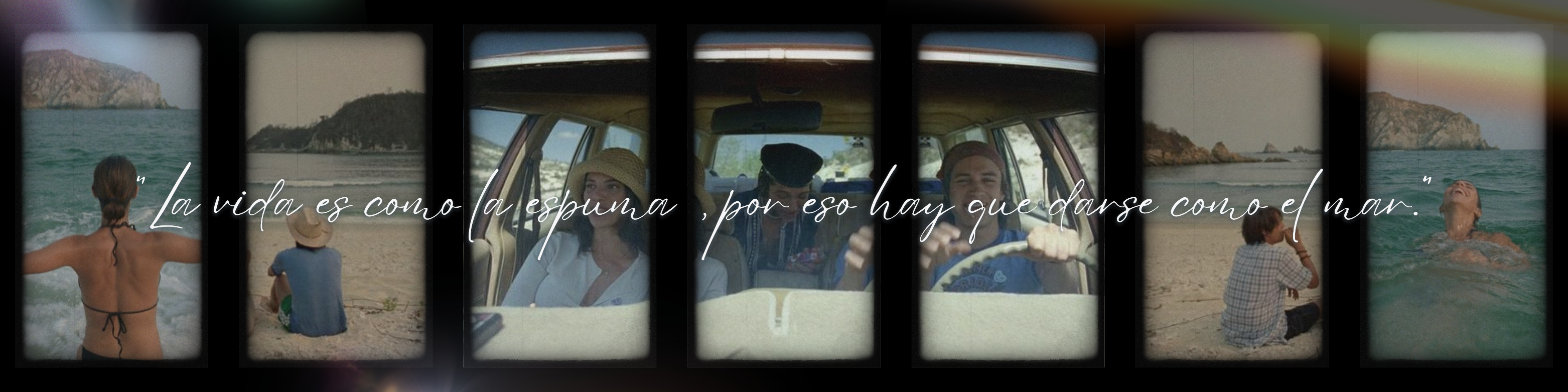
The 2001 Mexican film Y Tu Mamá También, directed by Alfonso Cuarón, is a coming-of-age story about two young men named Tenoch Iturbide and Julio Zapata and their road trip with an older woman named Luisa Cortés. In one of the final scenes of the movie, Luisa is walking away from Tenoch and Julio as they clean up their belongings off the shore; their impulsive trip to the beach has come to an end. Her back faces the camera as she unties her swimsuit cover from around her waist. All other audio, besides the narrator’s voice, ceases. As Luisa approaches the ocean and dives in, the narrator quotes her last words to Tenoch and Julio: “la vida es como la espuma, por eso hay que darse como el mar” (Life is like seafoam (or seaspray), that is why we must give ourselves like the ocean) (Y Tu Mamá También, 01:36:10). Her position and the silence of the scene work together to force the viewer to contemplate whether or not they will take on the challenge to surrender, to give oneself.
Though Luisa says this because she knew she was going to pass away soon from cancer, I find that the philosophy behind her words pertain to the notions of solidarity and justice that we have discussed in class. The first half of the quote (la vida es como la espuma), is a metaphor for human life that shows our mortality and lack of direction. The second half of the quote (por eso hay que darse como el mar), recommends that one lives a life led by sacrifice and generosity. To join something bigger than oneself and find a purpose, an aim. Luisa is telling Tenoch and Julio (us) that they must not fear the action of surrendering if they want to lead full and meaningful lives. Solidarity requires that we act for reasons beyond our individual needs and wants; it asks us to act for the necessities of a collective. In acting out solidarity we must leave our autonomy behind, our bodies must become part of a larger movement. The ocean is symbolic of these larger movements. It is fluid and commands force.
Tenoch, Julio, and Luisa spend a good amount of the film inside Julio’s sister’s car. It is a bubble that enables each character to act selfishly and egotistically—they argue a lot (over trivial things) and frequently feed into their own desires. The car creates an illusion of freedom and control. When inside, the group believes they are entirely detached from everything else going on in the landscape surrounding them. It is not until they arrive at the beach that they undergo the transformation that Luisa defines in her final words. The openness of the beach as well as the bond that they develop with a local family forces them to reflect on their future and what choices they must make (or lack thereof in Luisa’s case).
For us students, the classroom is our sister’s car. We spent almost four hours every week in class discussing and reflecting on readings that look into both historical and present systemic problems. There is no motion occurring besides the clicking of pens and tapping of keyboards. One might indulge in an overtly sweet coffee once class lets out just as Tenoch, Luisa, and Julio willfully look away from the economic devastation that surrounded them on their trip. They (we) are mere observers. We must enter the world rather than simply phase through it. By giving ourselves like the ocean, we reject the stagnation that enables injustices to remain. Joining this larger body that is the ocean, is us joining the masses that are moving in solidarity towards justice.
References
Y Tu Mamá También. Directed by Alfonso Cuarón, IFC Films, 2001.
