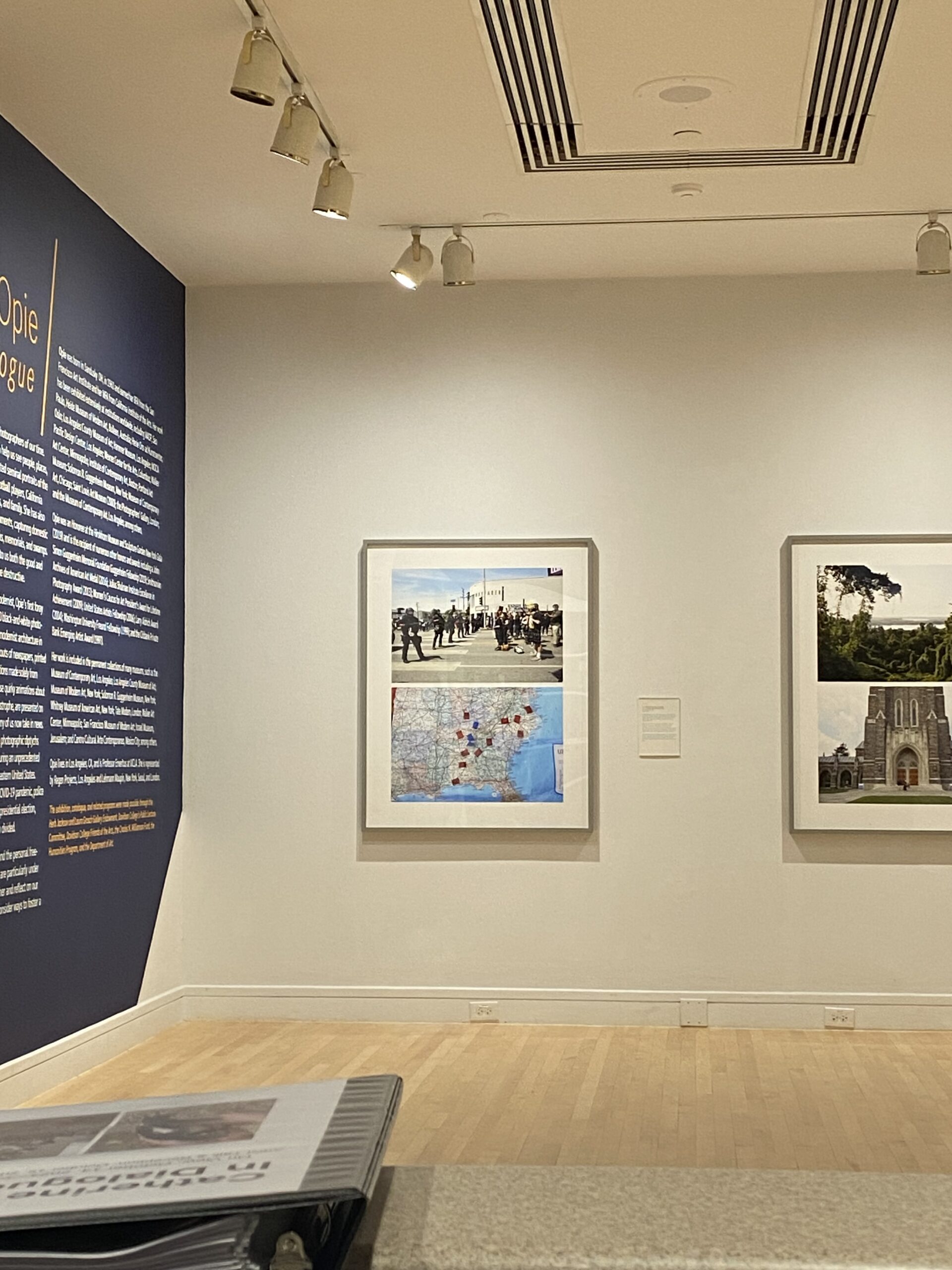
Catherine Opie’s exhibit, In Dialogue, will be on display at the Katherine and Tom Belk Visual Arts Center from October 14, 2024, through February 2, 2025. The exhibition consists of four of Opie’s past series made between the years of 2016-2020: 2020, monument/monumental, The Modernist, and Political Collages. The most apparent subjects within the exhibition are the confederate monuments, the Black Lives Matter (BLM) movement, elections, nature, and architecture. Opie finds a way to connect the photos of the 2020 series to one another through her diptych layout style; the works are not only related thematically, but also physically. Monument/monumental is a series of seven enlarged photographic prints that hang on the back wall of the Van Every gallery. The Modernist occupies the walls of the Smith gallery as a 21-minute film in black and white. Political Collages works in relation to The Modernist as short animated clips that are displayed on large monitors in the Van Every gallery.
In Dialogue was curated by Charlotte Cotton to further Catherine Opie’s goal of assisting the viewer in “[interpreting] and [navigating] the current cultural moment” 1 (Van Every/Smith Galleries at Davidson College) . Each series is dedicated to expressing Opie’s perspective on socio-political issues that have led to the fracturing of the country. The name, In Dialogue, epitomizes the three goals of this exhibition: production of conversation between individuals, a call for self-reflection, and keeping the current political issues and state of the country on the forefront of the audience’s mind. The first two goals listed are carried out by the viewers and their interactions with the artworks. The third goal is the overarching purpose of the exhibit. According to the wall-text at the exhibit, Opie’s aim as a photographer is “to help us see people, places, and subcultures that are often overlooked” 2 (Van Every/Smith Galleries at Davidson College) . She mainly focuses on police brutality, BLM, the presidential election of 2020, gun control, and southern communities.
Opie’s work was made to be seen before the results of this year’s election in acknowledgement of the “rapid change, profound uncertainty, and instability” 3 (Van Every/Smith Galleries at Davidson College) of modern society. As of now, December 2024, the United States presidential election has passed, altering the affective response elicited from the exhibit as it works through what it was anticipating. The traversing of time is seen in the photo series monument/monumental which depicts the monument of Robert E. Lee surrounded by unfocused shots of American landscapes. The monument has since been taken down as shown in one of the photographs. While removing Lee’s statue can be seen as a step forward, it can also be interpreted as the United States erasing their past for a clean slate and labeling the action as a reparation. Opie chose to arrange the photographs with sunsets on either side to symbolize how the United States addresses its cruel past while attempting to implement social change; Cotton describes it as a “forwards and backwards [step]” 4 (Van Every/Smith Galleries at Davidson College) . The sun will continue to rise and set for the unforeseeable future much like the United States will continue to strive for the justice of formerly and currently oppressed groups. In Dialogue is a memorialization and memorialization’s are essential to the nation’s aim for transitional justice.
When I first saw this exhibit, I honestly did not pay much attention to it, until I had to sit in the same room with it every Tuesday and Friday for work. It lingers in my mind for the rest of the day, and it is eerie to walk back outside into the world that voted against everything Opie stood so strongly for in her work. The diptych directly across from the front desk features a BLM protest in Los Angeles5 (LAPD and BLM protest, Los Angeles) . In Unit 4 we discussed the “Jordan Russell Davis” chapter of Loving Music Till It Hurts by William Cheng. I recall the killing of Michael Brown by police officer Darren Wilson that Cheng dissected through the lens of formidability bias and animalization of black people. Wilson felt threatened by his presumption of Michael Brown as some aggressive “thug” and uses it as justification for shooting Brown, this is formidability bias in action. Opie captures a haunting moment in which armed police officers are prepared to use their weapons against peaceful protesters—a systemic notion of fear.
Works Cited
Catherine Opie: In Dialogue, Van Every/Smith Galleries, Davidson, North Carolina, 2024, https://www.davidsoncollegeartgalleries.org/dcag-exhibitions/11543/. Accessed 2024.
Opie, Catherine. LAPD and BLM protest, Los Angeles. 2020. Davidson.
